
An Introduction to Asset Tracing
North Point's Thesis on Asset Tracing and Recovery
It's not just for judgment enforcement.
By most estimates, a majority of civil money judgments go uncollected. For most litigators, that number explains why asset tracing exists: a judgment is only as good as what you can find and reach, and by the time it is entered, assets have often moved, been retitled, or been spent. So tracing gets deployed at the end to rescue a recovery from a win that has already gone cold.
That instinct is right but incomplete. Tracing is most valuable not when judgment is entered, but long before — while you are still deciding whether to sue, whom to name, and where. The same discipline that locates a debtor's assets after judgment can, applied earlier, tell you whether the case is worth bringing at all, shape the remedies you seek, and preserve the value you will ultimately collect against.
That is North Point's thesis: asset tracing should be done early, often, and through multiple channels to help ensure recoverability.
Early, because the most consequential decisions in a dispute are made before an adversary has any reason to hide.
Often, because value moves throughout a case, not only at its close. And through
multiple channels, because no single instrument — least of all the subpoena — reveals the whole picture.
Part 1: The Attorney-Investigator Loop in Asset Tracing
Strip away the tradecraft and asset tracing answers four questions:
- What does this person or entity really own?
- Who actually controls it?
- Where and how is value moving?
- And what, of all of it, can we practically reach?
Each question exists because the same gap runs through every dispute over money. What is recorded, sworn, or claimed rarely matches what is true, sometimes because ownership is genuinely complex, sometimes because someone has worked hard to make it look that way. Tracing is the work of closing that gap.
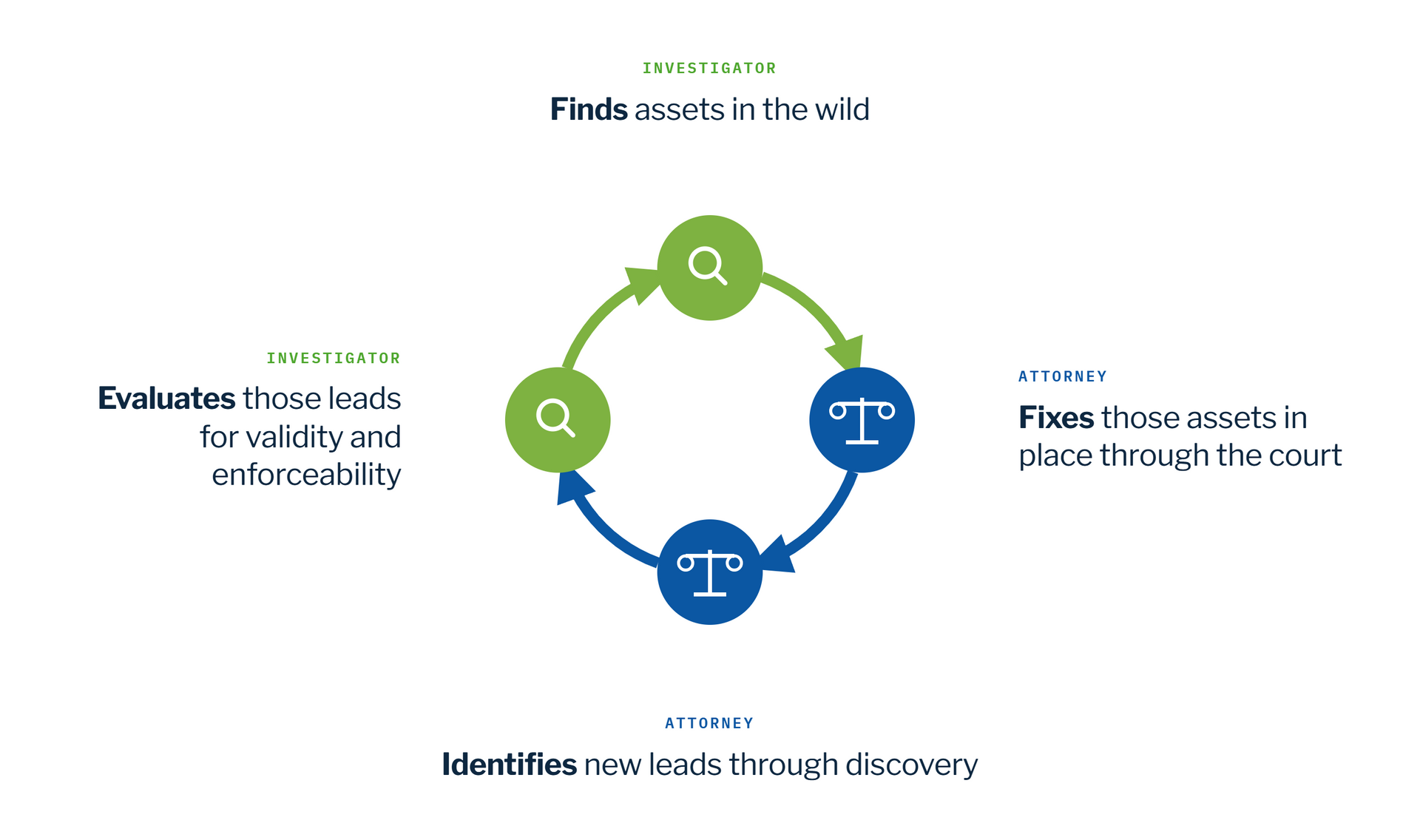
An attorney has two levers for closing it. The first is the court lever, compelling information through subpoenas, discovery, and sworn testimony. The second is the investigation lever, engaging a professional investigator to develop answers independently. Each lever is strong exactly where the other is weak. The court lever compels. It can force an answer no one would volunteer. But it is loud, slow, and only as reliable as the honesty of the person answering. The investigation lever needs no cooperation and makes no noise, but on its own it often cannot reach the last confirming document sitting behind a bank's wall. The best attorneys sequence the two so that each covers the other's blind spot. The external lever supplies the knowledge that makes compulsion precise and hard to evade. The court lever supplies the compulsion that turns an external lead into admissible fact.
Consider what happens without that sequencing. An attorney relying on court process alone tends to work by “spray and pray.” Discovery goes out seeking any account or asset it can name, followed by broad subpoenas to every third party that might hold something. The responding party produces the records of minor significance and stalls on the ones that matter, citing burden, relevance, or a tax return the accountant has not finished. Every request telegraphs the attorney's theory of where the money is, which is exactly the signal a sophisticated adversary uses to move it further out of reach. The process is slow, imprecise, and frequently the subject of its own satellite litigation. It tends to end when a client's budget or a judge's patience runs out, not when the assets have actually been found.
Sequenced well, the loop runs through the entire life of a dispute. An attorney has repeated occasions to identify, test, and restrain assets, from the provisional remedies available at the outset of a case, through discovery and depositions, to the enforcement tools that follow judgment. At each of those points the investigator narrows the target and the court's power fixes it in place. The sections that follow map those occasions in order, before a dispute, during it, and at its resolution.
Part 2: Asset Tracing During the Dispute Lifecycle
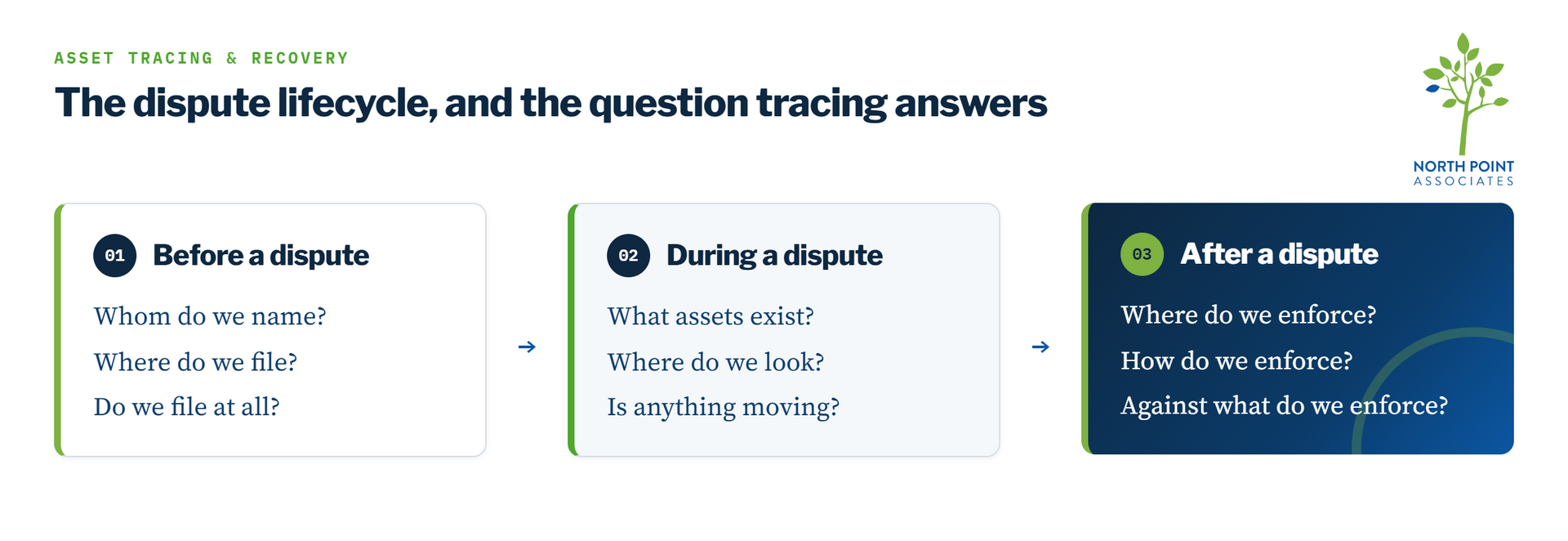
The four questions that anchored the attorney-investigator loop—ownership, control, movement of value, and practical reachability—are the throughline for every asset tracing inquiry. Those four questions apply across the three phases of a dispute: before it begins, during it, and as it moves toward resolution. Each phase carries its own toolkit, from temporary restraining orders and prejudgment attachments to preliminary injunctions and lis pendens. Laid against one another, the questions and the phases form a campaign map. From the first day of a matter, an attorney can chart what must be learned about a party's assets, when each answer will matter, and how it will be put to use, rather than reacting to each opportunity as it happens to arrive.
Before the Dispute
Most attorneys enter a dispute asking whether they have a claim. Investigators ask whether the claim is worth having. Some pre-dispute questions that asset tracing can help answer:
- Whether to sue at all — pre-suit collectability; the go/no-go decision; avoiding an expensive win against an empty shell. A plaintiff who spends two years and seven figures winning a $10 million judgment against a defendant whose only real asset was quietly mortgaged to a related party the year before has bought nothing but an unenforceable piece of paper.
- Whom to sue — defendant selection as an asset question: alter egos, guarantors, beneficial owners, co-conspirators, successor-liability targets. Naming only the operating company that signed the contract, while its solvent parent and the individual who siphoned its cash go unnamed, can leave a plaintiff litigating against the one entity in the structure deliberately left with nothing.
- Where to sue — jurisdiction and venue driven by where assets sit; using asset presence to establish or improve forum. Filing where the defendant is nominally headquartered rather than where its collectible assets actually sit can force a second enforcement fight in a foreign jurisdiction that a well-placed original filing would have avoided entirely.
- What it's worth / where they're vulnerable — claim valuation, litigation-finance underwriting, and the leverage map. The question is not merely can they pay (capacity) but where are they exposed (vulnerability). A defendant with ample capacity to pay may still settle early and generously once he learns the plaintiff has traced the undisclosed offshore account he assumed no one would ever find, because vulnerability, not capacity, is what moves a case.
During the Dispute
Once a dispute is underway, asset tracing does four things at once. It surfaces assets you did not know about, builds the factual groundwork for enforcement and settlement demands, sharpens discovery and depositions, and guards against the quiet dissipation of assets you have already found. The work in this phase tends to fall into four categories:
- Preserving the asset — Court remedies are only as good as the target you can identify and describe with specificity, because in the narrow cases where a court can restrain assets pre-judgment, it will not freeze what you cannot name. A motion to freeze "the defendant's bank accounts" will fail where a motion identifying the specific institution, account, and threatened transfer succeeds, and the difference between the two is investigation.
- Detecting dissipation in real time — voidable transaction and asset-dissipation analysis: transfers to a spouse, intercompany loans, interests that suddenly appear or shift, valuations that move the wrong way. Treated as an early-warning system rather than a post-mortem, it catches the movement while a court can still undo it. Catching a residence quietly retitled into a spouse's name in the weeks after a complaint is filed turns a routine transfer into the centerpiece of a fraudulent-conveyance claim, but only if someone is watching the records in real time.
- Discovery and truth-testing — targeting discovery so it lands, testing sworn financial disclosures against reality through lifestyle analysis, and, where the disclosures prove false, supplying the factual predicate for contempt or coercive-sanctions motion. The independent picture is what lets you tell the difference between a candid disclosure and a rehearsed one. A defendant who swears to a modest income while maintaining a waterfront home, a boat, and private-school tuition has handed you both a credibility problem and, potentially, the basis for a contempt motion once the lifestyle is documented against the sworn statement.
- Post-award, pre-confirmation — the dangerous gap in which a party knows the number but enforcement has not yet bitten, and has every incentive to move assets before it does. An arbitral award is not self-enforcing: the prevailing party must first have it confirmed into a judgment before any attachment or garnishment becomes available, and that interval is the vulnerability. Consider a losing respondent that, the day the award issues, begins wiring funds from its operating account through a chain of holding companies in opaque jurisdictions; by the time the claimant files to confirm, the money has cleared three borders and the account is empty, leaving an award that is intact on paper and worthless in practice. Monitoring the debtor's accounts through the confirmation window can surface that first transfer while there is still time to seek provisional relief in aid of enforcement.
Toward Resolution
A dispute ends in one of a few ways — a settlement, a judgment, or the debtor's insolvency — and asset tracing shapes what the client actually captures in each. Here the work turns from proving the case to securing what the case is worth.
- Settlement leverage — the party that knows the other side's true balance sheet negotiates from knowledge rather than hope, and often learns the adversary will pay more than his disclosures suggest he can. A corporate defendant that has written its receivables down to nothing on paper will resist a serious number until the plaintiff shows it has traced those receivables to a sister entity that is still quietly collecting on them.
- Settlement-security diligence — a settlement is only as good as the party's ability to fund it, and a structured deal only as good as the collateral behind it and the monitoring that follows. Accepting a five-year payment plan secured by a supposedly debt-free warehouse is a mistake worth catching before signing rather than after the third missed payment reveals two senior liens recorded the week before closing.
- Enforcement — converting a judgment into money, at home and abroad, and reaching wealth that never sits in an ordinary bank account. A judgment debtor who appears to own nothing may hold millions in art and collectibles, unpaid receivables, licensing royalties, or digital assets that a conventional bank-and-real-estate search never surfaces.
- The insolvency track — when the debtor files or is forced into bankruptcy, tracing supports creditor claims, receiverships, and the avoidance actions that pull value back into the estate. A trustee armed with a documented trail of the transfers a debtor made to insiders in the year before filing can recover those payments through avoidance actions that would be impossible to plead without the underlying trace.
Conclusion: Every Structure has a Beneficiary
SPVs, offshore trusts, private foundations, nominee directors and shareholders, layered holding companies, and family limited partnerships are often used to put distance between a person and what that person owns. North Point's working philosophy is that the person is the common denominator of every corporate structure. Every structure has a beneficiary, and beneficiaries are human. A holding company has no appetite. A trust does not want a larger house, a faster boat, or tuition paid in the fall. Behind every vehicle is a person who has things and wants things, and who leaves a trail precisely because he lives a life the structure cannot live for him.
That is why chasing the person is often faster than chasing the paper. The beneficiary is findable and knowable, tied to a lifestyle and a web of relationships that no amount of structuring fully conceals. The assets are scattered across jurisdictions and entities designed to keep you chasing. Start with the person, because it is the surest way to reach what the person owns. Looking at a case holistically — who are the people, what do they owe, which lever to pull and when — is what turns a favorable judgment into an actual recovery.
About the Author
Naphtali Rivkin is a Managing Director and Head of Investigations at North Point Associates. Over a career spanning the public and private sectors, he has built a reputation for tracing assets, locating people, and uncovering intelligence across the globe.
Naphtali brings a distinct educational and professional background to North Point beginning his career as a United States Army Intelligence officer and US Government intelligence analyst before transition to the private sector with the following degrees:
- BA in Russian Area Studies and English from Washington and Lee University
- M.Phil. in International Relations from the University of Cambridge (Clare College)
- Fulbright Scholar in Latvia
Naphtali holds the Professional Certified Investigator (PCI) designation from ASIS International, is a licensed private investigator, and was a 2024 Consulting Magazine Rising Star for Excellence in Client Services.