Voice of Customer: The Conversation Behind the Score
An Introduction to our Voice of Customer Research
North Point Associates’ Voice of the Customer (North Point VoC) focuses on interview-derived customer feedback instead of data points extrapolated from formulaic questioning. Through our approach we prompt customers to discuss how they see the business relationship, listen to their responses, and follow with inquiries that track the details they share. We have found this to be a distinctive approach that yields clarity rather than just analytical scores.
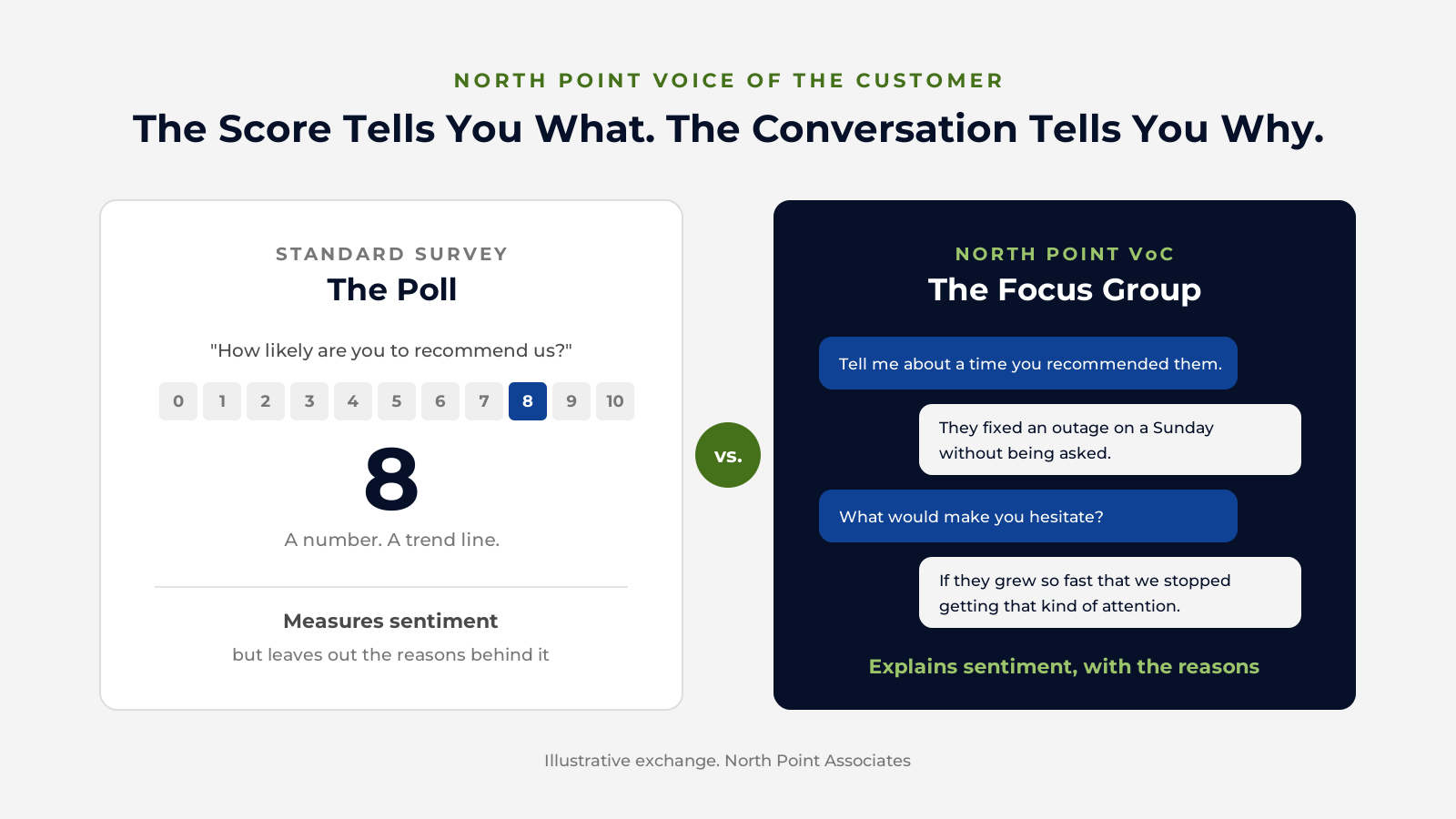
Take, for example, Net Promoter Score (NPS) considerations. Instead of asking the traditional “how likely are you to recommend the business?” we discuss situations in which the customer has recommended the business or, if applicable, reasons why they have been reluctant to promote the company. The result is not just a number, but the substance behind a customer's conviction.
The Focus Group, Not the Poll
The difference between North Point VoC and traditional studies is akin to the difference between political polling and a campaign focus group.
A poll can provide an approval rating or anticipated election outcome, but it doesn’t provide actionable information, doesn’t explain what a voter values, what gives them pause, or what would change their mind. For that, campaigns put people in a room and let them talk, because the conversation and responses to a good follow-up reveal reasoning that a checkbox never captures. The number measures sentiment; the conversation explains it.
Standard customer-feedback studies are the political polls of the business world. They produce tidy scores and trend lines useful for outward-facing representations, but they can flatten a complicated business relationship by avoiding the “why” altogether. North Point VoC is the focus group. We get customers talking, we listen, and we follow the thread wherever it leads. What emerges is an understanding of what has made a relationship successful, or details about the factors that have eroded it. Customers appreciate the chance to explain something that would be hard to reduce to a number or a few words but that matters to them.
How Our Clients Utilize North Point VoC in Due Diligence
Clients engage North Point VoC as part of their pre-close diligence process and for strategic planning within portfolio companies. In pre-close deal scenarios, North Point VoC adds value by factoring post-close objectives into our interviews to help clarify and stress test anticipated growth opportunities. We assess the strength of current relationships (and the reasons behind their current state) and solicit details concerning supplemental business offerings to gauge customer interest and current need. Clients pursuing roll-up strategies have built North Point VoC into their process to obtain insight into how a contemplated acquisition can align and benefit from being part of a larger and more capable operation.
We have found that the insight we provide is particularly valuable to smaller companies with high customer concentration, where the loss or erosion of a single relationship can materially alter the trajectory of the business. Standard scoring tends to obscure this exposure, treating each account as one data point among many, which dilutes the value of key customer feedback. North Point VoC gives disproportionate attention to these pivotal relationships, drawing out the specific reasons a key customer stays, expands, or hesitates, to help clients maintain and reinforce relationships that drive the business.
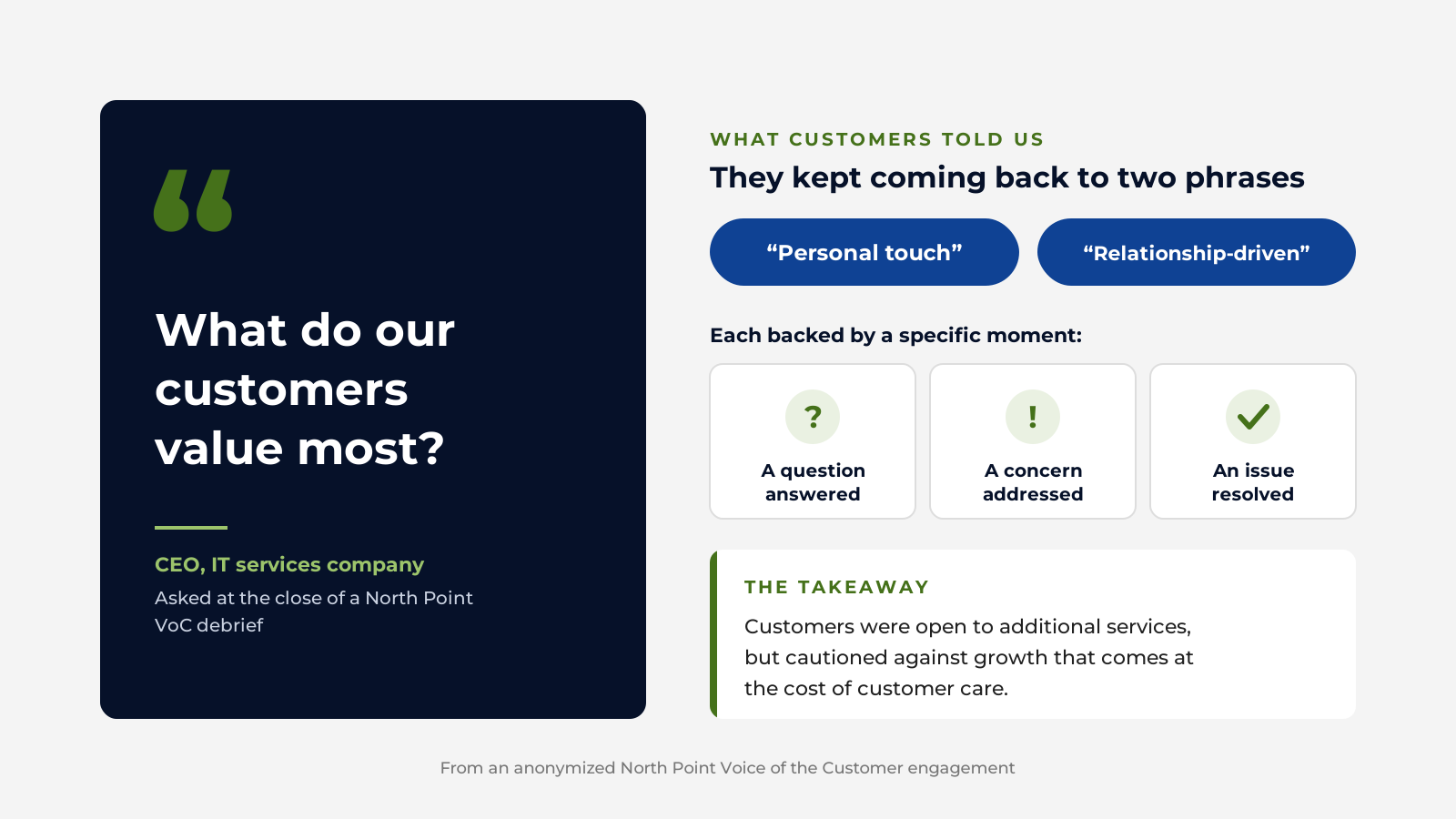
Across engagements, North Point delivers a clear read on relationship strength and details that drive customer satisfaction. After one long debrief, the CEO of an IT services company asked the question that mattered most: "What do our customers value most?" The answer was direct. Customers consistently pointed to the firm's "personal touch" and "relationship-driven approach," providing examples of a question answered, a concern addressed, or an issue resolved that left the impression the company understood and valued the relationship. Given that foundation, customers expressed an openness to additional services but cautioned against growth pursued at the cost of customer care.
Protecting Your Client Relationships
Beyond the findings themselves, North Point understands the sensitivity a business feels when a third party contacts its customers. Clients do not want to impose on customers or waste their time. Customers appreciate the care we take and preparation we do before a call, which allows us to tailor questioning to elicit relevant feedback, rather than working from a generic questionnaire. North Point's customer calls are led by in-house legal and research professionals with years of interview experience, who respect customer time and use discretion to keep conversations efficient while drawing out what matters.
While the need for North Point VoC spans pre- and post-acquisition scenarios, the current environment sharpens the use case. Tariff policy, interest-rate uncertainty, shifting federal priorities, and the accelerating adoption of AI are pressuring buying decisions in ways that are hard to anticipate. Customers are reassessing vendors, deferring projects, consolidating spend, and quietly re-evaluating relationships they once considered settled. An independent read through North Point VoC is an efficient and effective way to hear what customers are weighing, stabilize vital relationships, and forecast with greater confidence in a period of economic uncertainty.
About the Author
Ross Elwyn is a Managing Director at North Point Associates, where he leads qualitative due diligence engagements for private equity clients, focused on the professional, legal, and reputational factors that shape investment outcomes. He is also actively engaged in North Point's Voice of the Customer diligence service, delivering actionable customer insights that support post-close growth objectives.
Ross brings a decade of prior legal practice to his diligence work and holds a Juris Doctor and a Master of Environmental Law and Policy from Vermont Law School and a Bachelor of Science in Environmental and Resource Economics from the University of New Hampshire. He is admitted to practice in Massachusetts and New York.